
On Knowing Everything
Note: Stephen has suggested that the following is a little too long for the show notes for Sunday's show, so I'm presenting it here as a stand-alone entry.
I. The Question
The question is whether accelerating and converging technologies are leading us to a future in which we can all fully understand the world around us, and what kid of transformative effect on the world such an understanding wil provide. HapyCrow gives the example of repairing his own Jeep, and points out that doing the repairs himself it not always the economically effective approach. He then says:
It's a tall order to say that massive social change will happen when we can all work on our cars -- but when we can all comprehend the rest of the physical and political infrastructure around us, and represent them in a way that aids this comprehension, vast social and political change will be upon us. For starters, it will cut the legs out from underneath progressivism's assumption that technocrats need rule on our behalf. While that will discomfit political liberals, it will also provide cold comfort to the other sides of the aisle(s). If poorly-distributed, it could lead to techno-oligarchy (the informed making better decisions), or else it could lead to something radically less hierarchical and more communal.
It's unlikely that it would empower Marx' dream that one could be a fisherman in the morning, a painter in the afternoon, and write operas in the evening...for now, anyway, I suspect that not even brilliant software would make any opera of mine enjoyable. YET.
Let's put aside the question of political infrastructure -- for now -- and just look at the physical infrastructure.
Initial sniff test: Is understanding as big a deal as HC says?
Although I believe that massive increases in individual understanding of the world are on their way, I question the possibility of people achieving a full understanding of the world around us. But before we go there, let's spend some time pondering why it is that we don't already know everything.
II. Why we don't all know everything (a): distribution of knowledge
It is by design that we each don't understand everything about our physical world. If each of us could carry all human knowledge around, the total amount of human knowledge would have to be a tiny subset of what's available.
So each of us understands just a slice. This specialization of knowledge has been going on at least since the hunter-gatherer days. After all, some of us were hunters; some were gatherers. When the total amount of knowledge exceeded what one human being could reasonably carry around -- or even what one human being might reasonably need -- we started distributing knowledge amongst ourselves.
Today, knowledge is massively distributed amongst the population.
Not only do we not work on our own cars, we don't perform our own root canals.
Direct TV sends a guy out to calibrate the satellite dish -- most of us have no idea how to do that.
Many of us have someone do our taxes for us
Just this past weekend I spent $60 getting the sprinkler guy to come out and adjust watering times -- because I couldn't figure out the dials!
Distribution of knowledge is tremendously empowering. If all doctors were required to know everything about treating illness and injury, once again there would be a lot less TO know, and we wouldn't have specialists. No oncologists, pediatricians, endocrinologists, OBGYNs. A century ago, the model for medical practice was much closer to this. Today, we as consumers of health care benefit from the fact that doctors are empowered to specialize in whatever interests them most.
This brings up another interesting point: distribution of knowledge has been -- for the most part -- self-organizing. A more or less free market lets us have a society in which appropriate numbers of people earn how to be auto detailers, beauticians, civil engineers, and astronauts.
Interestingly, the wide distribution of knowledge is a problem for those who emphasize self-reliance and who worry about what to do if civilization hits some kind of reboot. One of HC's commenters says:
I have two advanced degrees, and AT BEST I think I could get me and mine back to the early stone age. I mean, sure, I can use a flint and steel if I've the gear, but I'm not your go-to guy for taking raw iron ore out of the ground. Tanning hides, making felt, and some VERY elementary spinning is about all I'm good for in that department.
Here's my problem with post-apocalyptic survivalist scenarios / fantasies: If things really do fall completely apart to the point that I'm going to have to spin my own yarn, tan my own leather, and freaking smelt my own iron ore, the chances that I personally will be one of the remnant of human survivors trying to set up Farnham's Freehold are close enough to zero that I just don't spend a lot of time worrying about it, much less preparing for it. If the world falls to that point, most of us won't be here well before we get to that point.
Plus, I believe there are strong arguments to made that we probably won't get to that point.
Yes, everyone's house should be well stocked with emergency supplies. But should we all learn how to tan leather so we're ready for the Mad Max world? Count me out.
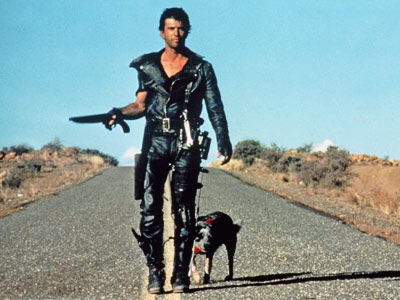
Sure, he wears leather, but we never see him tanning any.
III. Why we don't all know everything (b): embedding of knowledge
Knowledge has not just been distributed among human brains. It is encoded in books and other media -- and on the Web. Plus it has been embedded in technology. The obvious example while working on the computer is that few if any of us sit down to write our own operating system or software applications in machine language. We install working systems with all that knowledge embedded.
Basic example of embedded knowledge:
--Calculator
--Spelling checker
--Fuel injection system
--Personal robot assistant who
Gives you your meds
Send birthday cards to your loved ones
Changes your tire if you get a flat
Embedding of knowledge means that a scientist working in a modern, well-equipped lab doesn't have to worry about how to set up and manage the electric power grid (unless that's his or her area of expertise.) How to get power going is also not an issue for the lawyer working across the street from the scientist or the artist a few blocks away. Any of these folks can flip a switch and the lights come on. The whole difficult process of working up to ubiquitous electrical lighting is built into the flip of that switch.
Once again, embedding of knowledge is tremendously empowering. The digital revolution has made it much easier for the information component (i.e., the embedding of knowledge) to be recognized as the true value component of any technology.
We've discussed before how are able to do things like blog and podcast because access to publishing and reading (or transmission and reception) technologies hass ben made widespread. And these technologies have been made widespread through embedding of knowledge in our computers and in the Internet. Like distribution of knowledge, embedding of knowledge makes us less self-reliant. But we should note that it's a combination of embedding and distribution that makes our entire economy and technological infrastructure possible.
Getting back to the worst-case scenario folks, it's true that if you lose access to people to whom knowledge you need has been distributed, or if you lose key technologies with knowledge deeply embedded that it would be hard to figure out or recreate, we're hosed. It's a risk we have taken as part and parcel of enjoying technological and economic growth.
IV: So, are we facing a day when we can each understand everything?
Well...yes and no.
Here's the problem: our capacity to know and understand is about to take off on one of those beautiful hockey-stick curves that Kurzweil likes to show. Unfortunately, the amount of human knowledge is already way past the knee of its own exponential curve and pretty much rocketing straight up.
Will we ever catch up? Unlikely.
This means that -- as far as I can predict, anyway -- we will be as reliant on both distributed and embedded technologies in the future as we are today.
Interestingly, that doesn't mean that we can't know everything about the world. In 2030, an enhanced version of me might be able to know everything there is to know about...the world of 2009! (Or even the world of 2029.) But it seems unlikely that we'll ever know everything there is to know about the world in which we're currently living. The fact that we can know everything about fixing our Jeeps or go into the Matrix and learn Kung Fu instantaneously will be uber-cool, no doubt. For those interested in self-reliance, this is the point where we will achieve it. (If our big brains don't free us from dependence on other people, our nano-replicators will.)
But few of us will live in that fully self-reliant state any more than we do today. Today, many of us could buy a couple of acres and some goats and try to get by in a log cabin on just what we can scrape up from the earth -- but we don't do it. In the nano-replicator, learn-Kung-Fu-in-the-Matrix future, we will probably find a totally self-sufficient existing equally unappealing. There will always be more options if knowledge is distributed and embedded.
This has interesting implications:
1. To address the earlier question about the political infrastructure, we probably won't gain much of an advantage. Even if we're way smarter in the future, the political infrastructure is likely to be WAY way more complex than it currently is.
But we'll be able to look back at THIS era and understand it!
2. Even if material scarcity is eliminated and abundance reigns, we can still have an economy not all that different from the one we have today. That's because much knowledge will remain scarce. We know that we can function economically off the distribution of knowledge -- that's pretty much how the economy works today.
3. The choice will come down to a self-contained world in which we "know everything" -- and are pretty much all powerful, and a wider world in which we are just one of the players. Most people will choose to live in the latter simply because it's more fun.


Comments
Something you don't explicitly mention Phil is that understanding does not necessarily equal capability. By way of example, I understand how heavier-than-air flight works, I can even frequently repair such technology; I still can't (successfully) fly a plane off of an aircraft carrier flight deck despite having participated in literally thousands of such launches.
Knowing something, how it works or is made, doesn't automatically impart the ability to do that thing. Concepts like HappyCrow's or AI more generally commonly seem to assume the contrary. Physical multi-tasking is actually quite a complex condition to achieve. As a simple example, the skin callus developed from shooting or using a shovel doesn't comport with the hand and finger techniques common to hand sewing, especially for finely woven materials. I suspect this sort of complexity is far less recognised and accounted for then is often assumed in many futurist-style prognostications.
Posted by: Will Brown | June 2, 2009 01:01 PM
Something you don't explicitly mention Phil is that understanding does not necessarily equal capability. By way of example, I understand how heavier-than-air flight works, I can even frequently repair such technology; I still can't (successfully) fly a plane off of an aircraft carrier flight deck despite having participated in literally thousands of such launches.
Posted by: Mona | June 3, 2009 05:19 AM
The utility is not in understanding everything, but rather in understanding what you need to understand at any given moment. I'll probably never need to know what to do in case of a poisonous snake bite, but if I ever do need to know it, I REALLY need to know it. Also, even if I don't have the equipment and skills to repair my own car, having access to the knowledge of what conditions are likely to cause a given problem would greatly aid me in determining if my mechanic is screwing me over. Even marginal gains such as these, spread over the global population, could make the world a much more efficent place.
Posted by: David A. Young | June 3, 2009 10:54 AM