
A Few More Thoughts on Watchmen
On our most recent podcast, Stephen and I talked a little about the new movie Watchmen. While we both admired the film, we were hesitant to buy into what could be taken as one of its central moral arguments, that the ends justify the means and that -- read no further if you wish to avoid spoilers -- it's okay to kill several million people in an attempt to prevent a nuclear holocaust that would kill billions.
Stephen was quick to point out that this isn't necessarily an argument that the author is making. And, upon reflection, I think Alan Moore is getting at something else entirely.
After all, that argument is made by Ozymandias, essentially the "bad guy" of the story if I can be permitted such standard comic-book terminology. Ozymandias, we are told, is the Smartest Man in the World, and he has just perpetrated the murder of millions of innocent people in order to bring about a peaceful new world order. The logic of this plan is then accepted by Dr. Manhattan, who is even more powerful than Ozymandias (and smarter, too.) Who rejects the argument? Night Owl and the Silk Spectre, much lesser beings in terms of power and intellect than Ozymandias and Manhattan -- they disapprove on moral grounds but decide to play along. Rorschach, who has a simplistic, black-and-white view of the world, simply cannot accept what Ozymandias has done. Dr. Manhattan ratifies Ozymandias' scheme to bring about world peace; he kills Rorschach to keep him from spilling the beans and wrecking Utopia.
The question we always have to come back to is the philosophical quandary that inspired Alan Moore to give this assembly of heroes their name: "Who will watch the watchmen?"
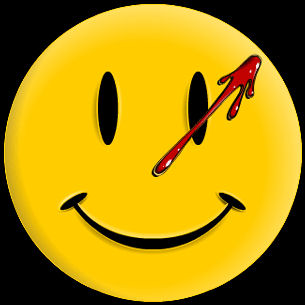
Ozymandias and Manhattan are accountable to no one. They do what they do because they have the power to do so. No one should have that kind of power, to decide the fate of others, to decide who gets to live and who gets to die -- even if they do what they do "for our own good." This would apply not just to superheroes, but to any authority. And now I begin to understand the reason for the preposterous politics in the story.
In The Dark Knight, a desperate game of Prisoner's Dilemma brought to life with two ferry boats wired with explosives results in a surprising denouement -- humanity's capacity for decency wins out. In Watchmen, we get no affirmation of human decency, nor even a resolution of the principle conflict. When the unwatched watchmen wield their power, some of those who should protest and fight back do not. (Just like real life.) But one does, and he dies for it.
However, the story does not end there. Rorschach left his diary where someone even less powerful and less heroic than he could find it and -- we hope -- act on it. That poor fat kid working at the newspaper is us.
Who will watch the watchmen? Nobody will if we don't.


Comments
Phil,
I would argue that at least in the graphic novel, Manhattan doesn't agree with him. Ozymandias, after it is done, says something to the order of "its finally over", to which Dr. Manhattan says "It's never over". Which of course segues nicely into the very last scene.
Which of course leads into the fact that noone can tie up all the loose ends.
Posted by: dantealiegri | March 10, 2009 06:45 AM
Dante --
Interesting. IIRC the line "It's never over" made it into the movie, only spoken by Silk Spectre. In the comic, did Manhattan kill Rorschach, and for the same reasons?
He, Night Owl, and Silk Spectre are not perpetrators of genocide -- they're accessories after the fact. That's an important distinction...but that distinction isn't exactly a defense.
Posted by: Phil Bowermaster | March 10, 2009 01:40 PM
Hmm, I'll have to see the movie. The end in the book happens quite rapidly, but of course, you can always read as slow as you want ...
In the book Dr. Manhattan decides to do nothing because I assume his calculus is that exposing the plot will not be worth it.
I always assume that Night Owl and Silk Spectre just give up in the end.
Posted by: dantealiegri | March 11, 2009 05:48 AM
Although I did like the movie, the Watchmen should have been a season on HBO. You needed al lot more time to the the story. Oz was not a villain, anti-hero might be a better term. He was a very good man driven to do a very evil act in order to stop what he thought would be a worse outcome. In the GN there is sub plot in which a boy is reading a comic (horror) book about a guy who is trying to stop pirates from attacking his home port. The stories parallel each other.
See it from Oz's perspective: Humanity's biggest danger is we have two heavily nuclear armed opponents but one side has a Super Powered Agent on its side. So it has been throwing its weight around internationally. The problem is Dr. Manhattan is caring less and less about humanity his only real connection is with an aging second generation female costume vigilante. Dr. Manhattan is going to be leaving sometime and when he does the international situation will go to hell because the US will not have its super powered agent to keep threatening everybody the US has been pushing around. So do you let the crisis play itself out "naturally" (with wide spread nuclear war as the likely out come) or do you try to "precipitate" the crisis in such a way the the guaranteed death is much lower?
Posted by: jim moore | March 11, 2009 07:31 PM
Jim --
Sure, Ozymadias doesn't see himself as evil, and he is acting with the best of intentions. The point is, there are no checks and balances in a world in which we're ruled over by self-appointed intellectually / physically superior elite.
See it from the point of view of one of the millions killed. You don't want to die? Tough. A person who is smarter than you and who has the power to do so has decided -- in secret, and as part of a secret plan - that your life is forfeit in the service of some greater good.
Besides, the world might turn away from nuclear annihilation even without Oz's heavy-handed assistance. That's how it worked in our world.
Posted by: Phil Bowermaster | March 12, 2009 07:01 AM
Good points, and (as a long-time fan of the work) exactly what I had hoped our society would be focused on, instead of the insane emphasis on whether the director went too far or not far enough in pleasing fanboys, and whether or not the non-"in"-group would "get it".
Is it OK to torture a fellow human being who happens to be a Muslim, who happens to be a "terrorist", even though we know torture is wrong, even though doing so might save some people's lives?
Questions like that is what "Watchmen" was supposed to be about.
Posted by: Lochmon | March 12, 2009 09:06 PM