
T. Boone Pickens Town Hall in Shreveport, LA
T. Boone Pickens came to my home town Shreveport yesterday as part of his campaign for the Pickens Plan. It was set to start at 10:30, and I showed up a few minutes early to make sure I could get a decent seat.
Out in front of the Shreveport Civic Center were two CNG vehicles. One was a GM Impala and the other was a Chesapeake work truck. Unfortunately neither is in production right now. If you want to be a CNG early adopter you essentially have one choice in the United States today - the Honda Civic GS CNG.
I got inside and got a great seat on the second row. When the rally started 30 minutes later, the room was completely full (picture gallery here [Hey, that's me in photo 8]).
A video showing T. Boone's travels on this campaign rolled to the tune of Johnny Cash's "I've Been Everywhere." T. Boone is shown hopping from city to city on various talk shows and rallies throughout the country.
Then our local Senator David Vitter came out and introduced T. Boone.
Pickens was given a standing ovation as he approached the podium from the back of the hall. Shreveport is a very friendly crowd for this guy. He's advocating a move from petroleum to natural gas to people living on top of the biggest gas field in the United States.
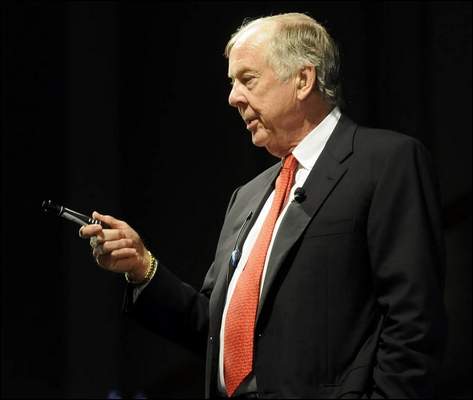
T. Boone looks like he's one of those rare 80-year-old guys with another 20 years left in him. He got to the stage and - with a quick hand up from Vitter - did this funny hop step 3 feet up onto the stage. He didn't bother with the stairs at the side of the stage.
He got straight to the point - we import 70% of our oil. Nixon thought we had a problem back when we imported 24% of our oil. At this summer's peak prices we were sending $700 Billion overseas annually for petroleum. We can't afford this now. And if we don't do something it will get worse. Pickens says that by 2018 we'll be paying $300 a barrel for oil. It will break this country.
Pickens did note that gas prices have gone down lately. The sagging economy has reduced demand, but Pickens also suggested that his campaign might be influencing gas prices to drop. Part of the price of a commodity today is the belief of what the demand for that commodity will be in the future. Gas prices will tend to drop to the extent that OPEC believes we can wean ourselves off our petroleum addiction.
In the meantime the problem is a trade deficit. Money sent out of this country to buy petroleum can't be spent here to build this economy. And petroleum tends to come from the world's most troubled spots. We send money there and, often, it's used to finance interests adverse to our own. We must find a way to make our own energy.
T. Boone is in favor of all forms of domestic energy production: solar, wind, natural gas, oil, coal, biofuels, nuclear, hydroelectric, geothermal, tidal, etc. He has nothing against oil except that we don't have enough of it domestically to power our economy long term. He unfortunately did not mention shale oil.
We make a significant percentage of our electricity with natural gas. But natural gas is an ideal fuel for transportation. Other forms of energy are not as easily adapted to transportation. Most of those energy sources (wind and solar for example) would need to be converted to electricity. And while battery technology has come a long way in the last few years, it's not ready yet.
Natural gas is ready. It's a mature technology that's already been widely adopted throughout the world. There are 3.5 million vehicles running on natural gas in the world (the US only has 142,000 CNG vehicles). Iran and Russia have huge oil reserves, but they are pushing to put their populations in natural gas vehicles. Why? So they can preserve their oil to sell at a premium to those countries that aren't making the wise move to natural gas. Right now that's us. We have just the one production vehicle in the United States that runs on natural gas. In Paris, France they have 23 different CNG vehicles.
For what our country has done for Iraq, Pickens argues that we should be given a call on their oil at market prices. This means we would get a right of first refusal to buy their oil at today's prices tomorrow. This is just another way to help stabilize our economy during this time.
There is a reason that Congress has done nothing in 30 years to address rising gas prices. Until recently gas has been cheap. It's hard for other sources of energy to compete against a $2 gallon of gasoline. But now that prices have risen we can find the will to make the move from gasoline.
It's not that Congress has been lying to the American people about energy. The truth is that they didn't understand the problem. From his work in energy Pickens argues he got the full picture. He began talking to his wife about it. About a year ago he woke his wife up at 3:00 am saying "We're heading toward a disaster. Who's going to warn the country?" Her reply, "You will... in the morning."
Boone said that at 80 years of age he's not worried about "making it to the finish line." He is worried about the future for his grand kids and their kids.
The world produces 85 million barrels of oil a day. The United States uses 21 million barrels a day. We use 25% of the oil, we have only 4% of the population, and we have only 3% of the world's oil reserves.
Pickens has nothing against oil. He thinks we should drill for more of our own oil. We just don't have enough oil to maintain our status as a developed nation. We have to plan today to do something else.
Natural gas is the obvious choice. In the question and answer portion the Caddo Magnet High School Debate Team Captain asked "why not clean coal for our cars?" Pickens agreed that we can make liquid fuel from coal that would be fine for transportation. But, he said, it's not as clean as natural gas, and it takes energy to make coal a liquid fuel. Natural gas is ready to use almost straight from the ground. It's abundant, cleaner, cheaper, and it's ours.
He only briefly mentioned alcohol fuels. He's not a big fan of corn-based ethanol because it hits the world's food supply. He thinks cellulosic ethanol is very promising but, for now, can't compete on a price basis with CNG. I wish he had spent a little more time on alcohol fuels. They are another important alternative fuel as we move away from gasoline.
Boone advocates using natural gas for automobiles and continue to use natural gas for heating. He was asked, "wouldn't that make natural gas prices go up?" Pickens answered "Yes." But one way to keep natural gas prices under control is to stop using natural gas to make electricity. Instead, we'll make electricity with wind and solar. He's all for nuclear power, but it will take years to get nuclear plants up and going. Wind and solar can be implemented immediately.
Pickens advocates production tax credits for wind and solar. Wind currently has a one-year production tax credit. Pickens would like to see that extended to a ten year credit.
Wind can revive the economy of the rural middle of the country. It's already had this effect on Sweet Water, TX. That formerly run-down town is now growing fast. I've seen this for myself. This is the area of the country my father-in-law grew up in. There's no NIMBY problem out there. Those windmills are considered a thing of beauty.
North of Sweet Water Boone is working on windmills in another Texas town - Pampa. In fact, the entire middle of the country - from south Texas to North Dakato - can be used for harvesting wind power. And its very handy to have the best wind in the middle of the country. It makes it easier to get power to both the east and west.
So, how do we make the move to natural gas? We've already started. As buses and public works vehicles wear out some municipalities are replacing them with natural gas vehicles. And cities are finding that just converting their trash truck fleets to CNG makes a difference in air quality.
Long haul truck are beginning to consider CNG. These companies are seeing diminishing returns with escalating diesel prices. CNG is comparatively cheap and, with the long range of their rigs they can service the entire country with just a couple dozen CNG stations located strategically throughout the country. We already have a few CNG 18 wheelers on the road.
Once we have a network of CNG fueling stations - smaller vehicles will begin to be adopted. Pickens already has a CNG vehicle. There is no CNG station near him so fuels up at home for local driving only. Home CNG compressors take 2-4 hours to fill a CNG tank at the equivalent of $1.50 per gallon. Compressors at commercial stations can fill up a CNG tank as fast as a gasoline tank can be filled.
Pickens says that it would be a good idea for his "Pickens Army" to begin asking car dealerships about CNG cars.
The government can encourage trucking companies to make the move to CNG with tax credits. Any taxes lost to such a program would be quickly recouped via dollars that stay in the country rather than shipped overseas for oil. It's a bargain to get our people off foreign fuel in favor of domestic fuel.
Pickens has invited others to come up with a better plan. If someone came up with a better plan Pickens promises that he would drop his plan and go with the new better plan. But Pickens believes he's examined the whole 52 card deck, and has picked out the trump cards for himself. Competing plans are at a disadvantage.
1,500,000 people have joined the "Pickens Army."
Boone thinks of CNG as a "bridge" fuel. Batteries will continue to improve and electric vehicles will follow. We might use biofuels or synthesized fuels or improved methods to liquefy coal. But CNG is the only alternative that's ready today.
One questioner asked about the environmental impact of drilling for natural gas. Boone's answer - which drew a applause - is that CNG is the cleanest fuel we have. Unless we choose to use no fuel, CNG is the next cleanest thing. Individual landowners are leasing their land for exploration; and they tend to safeguard the environment of their property more than government land. And gas companies seem to be doing a good job keeping their impact minimal.
A unit of energy produced by natural gas is about 25% of the cost of a unit of energy produced by gasoline.
Pickens is not happy with either candidate for President. He thinks both have borrowed parts of his plan, but neither have a full plan for weaning us off petroleum. McCain is focused on nuclear power. He wants 45 nuclear plants in the next 30 years. Boone is fine with nuclear as part of a long-term strategy. But, he argues, only the Pickens' Plan gives us the short-term solution to get us to McCain's nuclear powered future.
Obama wants a million new plug-in hybrids in ten years. Pickens reminded Obama that we have 250 million people in this country and 17 million new people every year. 1 million? We need an answer for 100's of millions.
Pickens said, jokingly, that he's considering running in four years. He's just a decade older than McCain.
A question was asked about how we can get past regulatory hurdles with establishing a new electric grid to move the new wind power east and west. Pickens said that back in the 50's Eisenhower mandated the Interstate Highway system. It was a necessity for national security. Boone mused, "Where would we be today without the Interstate system?" Today a new national electric grid is of comparable importance to national security. It should be given the same priority the Interstate highway system was given.
You can find out more by going to pickensplan.com.


Comments
The summery is very nice and good questions and answers and differences also there between natural gas and liquid fuel.
Posted by: Robot | November 12, 2008 03:13 AM