
Better All the Time #33
If the beginning of Spring (in this hemisphere, anyhow) wasn't enough good news for you this week, here are nine more news stories guaranteed to warm your heart and, perhaps more importantly, do something nice for your brain as well.
 | ||
|
This special edition of Better All The Time is devoted to what is still the most powerful and sophisticated computer in the world -- the human brain. There is a lot of exciting stuff happening these days, brain-wise. Enjoy these nine examples.
|




The chief function of the body is to carry the brain around.
Thomas Edison
Item 1
The
Adult brain cells stop growing myth
Since there are still a big number of things we fail to understand about our brain it is somewhat understandable that such theories appear. They turn into myths and thanks to the oh so well documented media everybody thinks that they are true; and such a belief is hard to shatter even when it refers to something untrue.
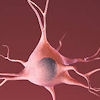
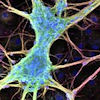
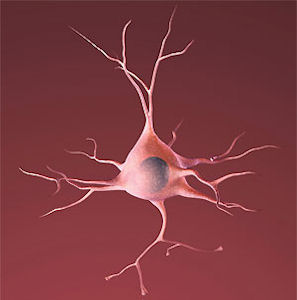
This could just be the case here. The fact that after a man has reached adulthood his brain cells stop growing is just not true. Researchers at MIT led by Wei-Chung Allen Lee have showed this. In fact the busting of this myth means proving that adult brain cells, or neurons, are not largely static and that they are able to change their structures in response to new experiences. The study they made showed that the branch-like projections on some neurons, called“dendrites,” were still physically malleable.
They conduct electricity received from other neurons to the parent neuron’s cell body. The changes occurred both incrementally and in short bursts, and involved both growth and shrinkage. The results were surprising. A dendrite was able to double its length in two weeks. In the early years of your life you manufacture an estimated 250,000 neurons per minute and then spend the next few years wiring them together. The myth assumes that plasticity settles down when you reach adulthood.
The Good News:
If our brains really do keep growing and remain malleable into adulthood, we don't have quite the excuse base we might have thought we have for shying away from new knowledge and new experiences. If you don't want to learn something new, don't blame your brain! It's ready to go.
Item 2
New
findings about the brain lead to treatment for eating disturbances
The discovery of the brain's so-called melanocortin system and its central role in controlling appetite has paved the way for entirely new possibilities for treating obesity and anorexia. In the latest issue of the prestigious journal Nature Reviews Drug Discovery, Uppsala University researcher Jarl Wikberg and one of his associates present a review of pioneering research in this field that he and other scientists have conducted over nearly two decades.
The mapping of the melanocortin system was made possible by the cloning of genes for five different melanocortin receptors, which was performed by Jarl Wikberg in collaboration with other researchers in the early 1990s.
"The melanocortin system monitors the energy balance and regulates how much we eat and how much energy the body uses. The result of all of this is that we maintain our body weight," says Jarl Wikberg.
But things can go wrong. It is a highly complex system, and even tiny imbalances can entail major changes. For instance, the melanocortin system is exposed to great genetic variations, and many mutations lead to extreme obesity in early ages. Such mutations are found in 3?6 percent of children who have these problems.
The Good News
There has been no shortage over the years of theories as to what causes obesity and eating disorders, must of which fall back on the old chestnut that it's "all in your head." Seeing as that is likely the case, how encouraging that we might finally be getting a handle on exactly where in your head it all is, and what exactly we might do about it.

Item 3
Hack
your brain
Your mind: it's just another piece of hardware. Make sure you download the latest patch and upgrade to the newest operating system.
That, in so many words, is the fate of humankind described by David Pescovitz, co-editor of the BoingBoing.net blog and research director with the Institute for the Future.
We've long used caffeine and various other drugs to alter our states of mind. But those are "really blunt instruments" compared with the future technology that advances in neuroscience will bring, Pescovitz said Tuesday as he moderated a panel discussion on the "future of mind hacks" at the O’Reilly ETech conference on emerging technology in San Diego.
"In the near future, these technologies will be available to us to help us take control of our own minds, to alter our own minds – to bring a DIY hacker mentality to your own head," Pescovitz said.
The good news...
I especially like the idea of being able to download patches. I can see these coming in two forms. Initially, we might look to patch our innate ability. So if you lack, say, basic math or music skills, you could instantly make yourself more amenable to learning those two subjects. But the next phase of patches will be even more exciting -- direct knowledge transfer. Let's say your math aptitude is okay -- or even pretty good -- but you never got around to learning calculus. No prob, just download the patch and, poof! You know calculus. Or how to play the piano. Think of Keanu Reeves instantly learning Kung Fu in The Matrix.
Of course, this level of brain hacking will revolutionize education. Education becomes much faster (virtually instantaneous) in the age of the hackable brain. Sure, many will argue that knowledge gained in this way will not be as valuable, that the hard work and discipline of learning are what make the experience worthwhile. Possibly. On the other hand, there's still a role for hard work and discipline to play. Like what are you going to do with all that new knowledge now that you have it?

Item 4
Virus Infection Battles Brain Cancer
March 10, 2008 -- Curing a disease by causing another one seems counter-intuitive, but that's just what scientists at Yale University have done.
Specifically, they have modified a virus and injected it into mice with several kinds of inoperable brain cancer. Three days later, the tumors were gone.
The research, which builds on previous attempts to use viruses to treat cancer, could eventually treat otherwise fatal brain tumors in people, as well as other forms of cancer. While a human treatment is still years away and subject to federal approval, a tumor-killing virus could be a last-resort try at saving lives.
The Good News:
Viruses are nasty and efficient little killers. They're tough, they're relentless, and they really get around. Of course there are significant risks involved in any attempt to harness viruses, but the thought of putting their natural destructive capabilities in the service of wiping out cancer is a very appealing one. Here's hoping that this research leads to more than just the destruction of cancer in mice.
Item 5
Single brain cell's
power shown
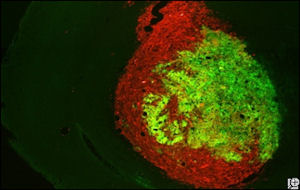
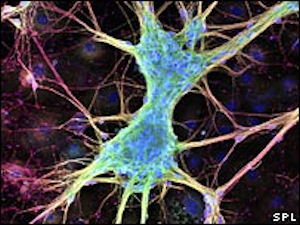
There could be enough computing ability in just one brain cell to allow humans and animals to feel, a study suggests.
The brain has 100 billion neurons but scientists had thought they needed to join forces in larger networks to produce thoughts and sensations.
The Dutch and German study, published in Nature, found that stimulating just one rat neuron could deliver the sensation of touch.
The good news:
Our understanding of how the brain works is expanding across the board. We're getting a better idea of how it functions and how those functions turn into phenomena that we call thinking and feeling. Plus, as we've seen above, we're getting a better idea of how to heal the brain when it is threatened by disease or when its improper functioning threatens the health of the rest of our bodies.
Now we can see what's happening at the level of a single neuron -- one out 100 billion or so that we're each carrying around between our ears -- and, moreover, we are learning just how significant the function of even one of them can be. This says to me that the really big brain breakthroughs are yet to come. And will probably be coming much sooner than most of us suspect.
Item 6
Tiny
Brain-Like Computer Created
The most powerful computer known is the brain, and now scientists have designed a machine just a few molecules large that mimics how the brain works.
So far the device can simultaneously carry out 16 times more operations than a normal computer transistor. Researchers suggest the invention might eventually prove able to perform roughly 1,000 times more operations than a transistor.
This machine could not only serve as the foundation of a powerful computer, but also serve as the controlling element of complex gadgets such as microscopic doctors or factories, scientists added.
The good news:
It isn't always the case that the obvious model from nature turns out to be the right one to follow when attempting to replicate one of nature's functions in the mechanical world. For example, early attempts at creating heaver-than-air human flight were deeply flawed by attempts to make aircraft that simulated the flapping of a bird's wings. But here we have an example where nature's model might have quite a bit to offer us.
One of the ideas often suggested for achieving brute-force artificial intelligence is the use of a computer to simulate an entire human brain. Basing computer designs on the structure of the brain is a different task entirely, but it suggests the beginning of a conversation between human and mechanical thinking machines. The conversation promises to be a long, thoughtful, and rewarding one.

Top
Item 7
Meditation
Found To Increase Brain Size
People who meditate grow bigger brains than those who don't. Researchers at Harvard, Yale, and the Massachusetts Institute of Technology have found the first evidence that meditation can alter the physical structure of our brains. Brain scans they conducted reveal that experienced meditators boasted increased thickness in parts of the brain that deal with attention and processing sensory input.
In one area of gray matter, the thickening turns out to be more pronounced in older than in younger people. That's intriguing because those sections of the human cortex, or thinking cap, normally get thinner as we age.
"Our data suggest that meditation practice can promote cortical plasticity in adults in areas important for cognitive and emotional processing and well-being," says Sara Lazar, leader of the study and a psychologist at Harvard Medical School. "These findings are consistent with other studies that demonstrated increased thickness of music areas in the brains of musicians, and visual and motor areas in the brains of jugglers. In other words, the structure of an adult brain can change in response to repeated practice."
The good news:
So not only can we grow new cells;we can actually make our entire brains bigger -- and healthier, it would seem -- through a practice which has a number of other health benefits associated with it. It turns out our brains thrive if we treat them right. We need to feed them right, we need to think with them, and we need to relax with them. I guess it's no great mystery that things we need to do to take care of our brains are many of the same things we need to do to take care of ourselves. After all, they are us!

Brain Scanner Can Tell What You're Looking At
Tell me what you see.
On second thought, don't: A computer will soon be able to do it, simply by analyzing the activity of your brain.
That's the promise of a decoding system unveiled this week in Nature by neuroscientists from the University of California at Berkeley.
The scientists used a functional magnetic resonance imaging machine -- a real-time brain scanner -- to record the mental activity of a person looking at thousands of random pictures: people, animals, landscapes, objects, the stuff of everyday visual life. With those recordings the researchers built a computational model for predicting the mental patterns elicited by looking at any other photograph. When tested with neurological readouts generated by a different set of pictures, the decoder passed with flying colors, identifying the images seen with unprecedented accuracy.
The Good News:
Getting a handle on what goes on inside the brain to drive the process that we call "seeing" has many implications in a wide variety of areas: medicine, business, the law, and others. For example, if we understand what's happening in the brain well enough, wouldn't we eventually be able to feed visual information straight in? Think of the implications for treating visual impairment. Having damaged or injured eyes (or no eyes at all) might no longer prevent a person from seeing.
Some possible downsides:
The linked article speculates that advertisers might be able to wage much more effective campaigns based on empirical knowledge of how images impact the brain. That's a little disturbing. And what happens within the judicial system to the concept of an eyewitness if no one is ever 100% sure what they're seeing vs. what's being piped into their heads? Yikes.
The biggest commercial application...
will almost certainly be entertainment. Who is going to bother even with a 100-inch HDTV display when programming can be fed into our entire visual field? Plus, the article mentions that one of the interesting possibilities of this research is that we may be able to decode the visual component of dreams. From there, it's just a short step to a full-fledged dream industry.
Sounds far-fetched? Well read on.

Brain-Computer Interfaces for Manipulating Dreams
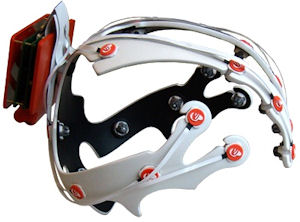
A first-generation commercial brain-computer interface (BCI) is being released by Emotiv Systems later this year. What does the future hold for BCI?
By 2050, and likely sooner, you will be able to buy a BCI device that records all your dreams in their entirety. This will be done in one of two ways. One method would be to use distributed nanobots less than a micrometer in diameter to spread throughout the brain and monitor the activation patterns of neurons. By this point, cognitive science will have advanced enough to know which neural activation patterns correspond to which sensory experiences.
Blogger Michael Anissimov lists a number of possible implications for such research, including:
Validate or refute Freudian theories about the connections of dreams to subconscious or conscious psychological states.
Create a “science of dreams”, or oneirology, that organizes all available dream data, breaks up dreams into categories, studies which type of people get which dreams, etc.
Create a “dream entertainment industry” where people choose to have customized dreams, with features like greater visual complexity or richness of colors, or even massively multiplayer dreams.
Convert dream-worlds into real-worlds; amusement parks based on dreams, or utility fog banks that quickly morph in response to a given personal or collective dreamscape. Or vice versa: turn real world places and people into dream objects.
In general, blur the line between dreams and reality by making dreams more tangible, manipulable, interactive, customizable, and social. Bring dreams “in from the cold”. Make dreams as mysterious, colorful, productive, foreign, erotic, or mundane as you want them to be.
There are those who claim to be lucid dreamers -- that is, they say that they can maintain conscious control over their dreaming environment. With a technology such as this available, we would all potentially be lucid dreamers. The possibilities are limited only by what we can imagine. And as our brains have shown us to date, we can imagine quite a bit.
For more brain-related good news, check out this week's FastForward Radio.
Better All The Time was compiled by Phil Bowermaster. Live to see it!


Comments
In regards to item number 4, wasn't this the premise behind "I am Legend"? Viruses can be used to fight cancer or other diseases. Kind of cool when life imitates art. (Of course, we will hope that the side-effects are not quite as bad in life as they were in the movie.
Posted by: Ross the Heartless Conservative![[TypeKey Profile Page]](http://www.blog.speculist.com/nav-commenters.gif) |
March 29, 2008 11:42 AM
|
March 29, 2008 11:42 AM