
Fusion Power Breakthrough
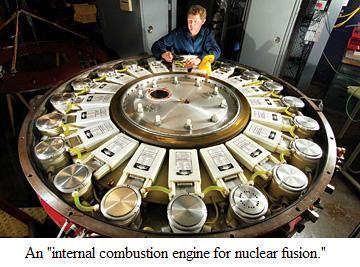
We got big news this week from the Sandia National Laboratories. A working fusion power plant may be decades closer than we thought:
ALBUQUERQUE, N.M. — An electrical circuit that should carry enough power to produce the long-sought goal of controlled high-yield nuclear fusion and, equally important, do it every 10 seconds, has undergone extensive preliminary experiments and computer simulations at Sandia National Laboratories’ Z machine facility...
Until recently, Z machines would fire and then wait for days or hours before firing again. This breakthrough allows the repetitive firing that will be necessary in an inertial confinement fusion reactor. It has been compared to an "internal combustion engine for nuclear fusion."
A test cavity in Sandia’s Technical Area 4 has fired without flaw more than 11,000 times...Because the cavities are modular, they can be stacked like donuts on a metal prong called a stalk. Arranged in a suitable configuration, they could generate 60 megamperes and six megavolts of electrical power, enough (theoretically) to generate high-yield nuclear fusion within the parameters necessary to run an electrical power plant.
Theoretically this breakthrough could lead to a working fusion power plant in twenty years.
“It’s like building a tinker toy,” says [Keith Matzen, director of Sandia’s Pulsed Power Center]. “We think we need 60 megamperes to make large fusion yields. But though our simulations show it can be done, we won’t know for certain until we actually build it.”
The potential is abundant energy from an abundant resource - ocean water. Deuterium from a single liter of ocean water would yield the energy equivalent of 300 liters of gasoline.
UPDATE FROM PHIL:
So we've got at least one good option for the near-to-mid term -- nuclear fission reactors; a good possibility opening up for the mid-to-long term -- nuclear fusion reactors; and at least one good idea for the very long term -- helium 3 reactors, or perhaps massive solar energy collection from space; until we finally get to something like the Ancients' ZPM. (See, I don't always relate everything to Star Trek.)
The trick is how do we get from here to there? Is there enough foresight in government or the private sector to start pushing us in this direction on a large scale, or does a major oil shortage have to occur before we begin to do anything serious? And even if we run low on oil, will we switch back to coal or go with shale or some other alternative source of petroleum (or petroleum-like juice) before getting serious about nuclear?
This is where the current awareness/concern/hysteria (take your pick) over global warming can really help. Fission and fusion are both zero-emission means of getting energy. I was discussing this with commenter MDarling the other day and we came to the conclusion that if we could run our power grid from nuclear power (including cars) we could save the oil for the one piece of infrastructure that (currently) can't really run by any other means -- airplanes.
A good environmental goal would be to get America's fossil fuel emissions down to just what is produced by commercial (and Al Gore's private) aircraft. That might still be a lot, but it would be a huge step in the right direction.
UPDATE FROM STEPHEN:
I agree, the short-term future is also bright. I'm especially excited by the advances in solar, oil-from-algae, and lithium-ion batteries.


Comments
the Z machine can reach 2 billion degrees kelvin, so it can burn helium 3.
the z machine is also the basis for minimag orion by Andrews space Inc
http://advancednano.blogspot.com/2006/10/minimag-orion-and-follow-on-ideas.html
So this path to fusion power give us fusion rockets too.
We need a DARPA for energy projects and we need scientifically competent political leaders or political leaders who are able to work effectively with those who are technically competetent.
Chuck deVore out of California is such a politician.
Pretty much all of the candidates for president are favorable to nuclear power
http://www.nysun.com/article/52902
Posted by: advancednano![[TypeKey Profile Page]](http://www.blog.speculist.com/nav-commenters.gif) |
May 4, 2007 12:57 PM
|
May 4, 2007 12:57 PM