
Question for the Day
Captain Capitalism (via Reddit) shares this picture and declares that the party is over.
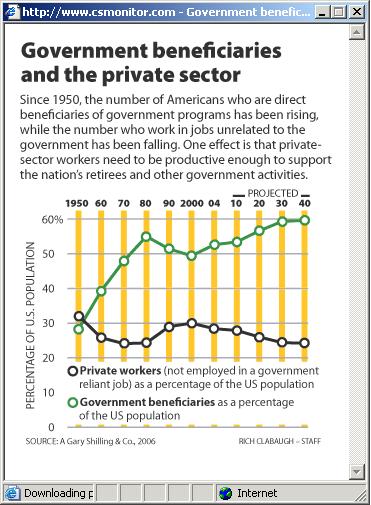
Actually, from reading the trend line, I would say that the party has leveled off somewhat. But my question is, where does the green line go next?
Do we all end up working for the government? Or does a correction take place where the two lines start moving towards each other? Extra credit if your answer is phrased as a projection of the future rather than a political rant!


Comments
1) There is significant overlap in the two groups. ANd the overlap will get get bigger.
2) IN the near future, the workers will unite and revolt- FICA and other payroll taxes will be seen as the regressive punishment for working that they are.
3) In the more distant future... labor (L) will fight for return (rent) equal to that which goes to capital (K) and innovation (A) will side with labor.
Labor will lose- capital always has the advantage - but capital will consume itself and create global instability where the uber wealthy in their gated islands will be unable to sustain production, let alone productivity.
Oh- and the Cubs will win it all two years out of three and there will be no more money.
Posted by: MDarling![[TypeKey Profile Page]](http://www.blog.speculist.com/nav-commenters.gif) |
April 19, 2007 11:24 AM
|
April 19, 2007 11:24 AM
But L is getting smaller all the time! Productivity is going up while the number of people who actually produce anything (material) is going down. Machines do the producing now. I think we're not that far from an era when we'll all be management. There won't be anyone left to rebel but the Cylons.
Posted by: Phil Bowermaster![[TypeKey Profile Page]](http://www.blog.speculist.com/nav-commenters.gif) |
April 19, 2007 06:06 PM
|
April 19, 2007 06:06 PM
Where are they getting those projections?
The green bar has been falling since 1980, with a small bump between 2000 and '04, likely caused by the recession during that period.
Maybe extrapolating from a single datapoint (the '04 number) to make a political point?
I'm gonna take most of that with a grain of salt. The general trends don't back up what the article is trying to say, only trends that the article can "project" without telling us the method of said projection.
Posted by: Vadept![[TypeKey Profile Page]](http://www.blog.speculist.com/nav-commenters.gif) |
April 20, 2007 03:00 AM
|
April 20, 2007 03:00 AM
Phil:
As you said, this trend toward government employment seems to have leveled off.
So I agree with Vadept that this article appears to be massaging the data pretty hard for its point.
There's a related problem that I believe could be much more serious - retiring baby boomers. A much larger number of people will be drawing social security from a smaller number of working people.
Accelerating tech to the rescue. Those who work are becoming more productive. AND, hopefully, life extension technology will allow longer working lives for boomers and those to follow.
Posted by: Stephen Gordon![[TypeKey Profile Page]](http://www.blog.speculist.com/nav-commenters.gif) |
April 20, 2007 07:46 AM
|
April 20, 2007 07:46 AM
"But L is getting smaller all the time!"
Sort of.
And that's essentially here the A comes from - A is innovation. So the classic output equals a function of capital and labor, is shifting to acknoweldge what perhaps should have been obvious all along- innovation and labor are essentially different contributions. Innovation as defined (Romer should win the Nobel for this someday) is best paraphrased as intellectual capital (and the economists working on it treat it more like capital than labor).
We can't all be managers- capital wouldn't like that. It would disinvest and seek higher return or less risk. Though I suppose we could all be maintenance for the machines.
The retirement wave of boomers needs to realize that the "retirement age" needs to increase. An individual should be able to quit working anytime they want- but as for social security and medicare- as insurance plans they were designed and built with very different demographic and actuarial assumptions than we live with now. And though its fun to think about retiring at 65 (arbitrary round number that is also racist and unfair) and living to 105 in good health- 65 was chosen because the typical experience was a fairly rapid decline in health to death 6-8 years later. Not 36. Not 26. 6.
Posted by: MDarling![[TypeKey Profile Page]](http://www.blog.speculist.com/nav-commenters.gif) |
April 20, 2007 03:04 PM
|
April 20, 2007 03:04 PM