Bicentennial Man
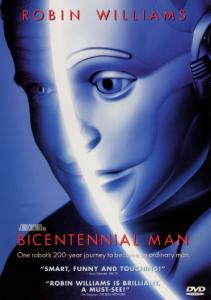 Yes, I'm a tad late writing a movie review of Robin William's Bicentennial Man. The movie is six years old this year. But at least this way I don't have to worry too much about spoiling it for anybody. If you still haven't seen the movie and want to know if it's worth your time - it is.
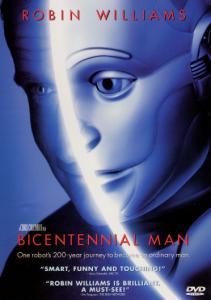
I give it a "B+."
SPOILERS:
This movie got a bum rap I think because it was lumped in with Robin Williams' man-child movie phase. For the better part of a decade Williams found every possible way to play the wide-eyed innocent. This had gotten annoying by 1999.
It was marketed poorly too. The trailer showed Williams' character Andrew on the operating table with his robot interior exposed saying, "I'm trying to make something of myself." It also played his fall from the second floor as slapstick. Those who went to this movie expecting "Williams the comic genius" probably left disappointed. This was no comedy.
So the movie got an unfair reputation as mediocre. Yes, Williams played the man-child again, but he was much less annoying here than in other movies. The character was trying to become human - an adult human - and Williams played it serious.
If you went into this movie hoping for a thoughtful treatment of the Asimov source material you probably liked it better. This was not a slavish adaptation of the Asimov short story or novel, but it dealt with the same moral issues in a way I think the author would have (mostly) appreciated. I can't say the same thing for "I, Robot."
The movie starts with Andrew rolling off a robot assembly line in April of 2005. Er...perhaps they should have set this a little further into the future. If we remade it today with the same start date it would have to be the story of a very special Roomba.
Andrew is delivered to the impossibly posh home of the Martin family. The entire movie has a highbrow feel to it. Apparently nobody listens to anything but classical music in the future, chess is the national pastime, and we all live lives of quiet contemplation. Okay, I'll suspend my disbelief on that issue for this movie, but I'd guess that life in the future will be much more chaotic than what was shown here. Like now but more so. And that's probably a good thing.
The Martin's open up Andrew's crate and he quickly does a presentation on the three laws of robotics. You probably know them already:
- A robot may not injure a human being or, through inaction, allow a human being to come to harm.
- A robot must obey orders given it by human beings except where such orders would conflict with the First Law.
- A robot must protect its own existence as long as such protection does not conflict with the First or Second Law.
So when the Martin family bad girl orders Andrew to jump out of the second floor window, he immediately complies and is damaged. But then something weird happens. The movie forgets about the three laws. Andrew wants a bank account? Fine, but I have to ask, what if some stranger asks for his money? If Andrew is subject to the second law he'll have to hand it over, no questions asked. That problem is not dealt with.
And then, at the end of the movie, Andrew chooses to age and die like a human rather than live as a machine. What about the third law?
The movie suggests that Andrew's experiences add to his complexity. Perhaps the laws faded in Andrew's mind because of that. Maybe. But the film never explained it. For an otherwise thoughtful sci-fi flick, that's a big issue to ignore.
My other problem is how the show deals with life extension technology. Around the year 2070 Andrew begins to invent artificial organs and a central nervous system. This is part of his effort to become more human, but this technology is also useful in people. Later as his wife Portia begins to age he invents a life extending elixir - the movie hints this was in his second century - 2105 or after.
So, we don't have replacement organs before 2070 or life extension before 2105? Arguably, writer Nicholas Kazan was being as unduly pessimistic on these subjects as he was unduly optimistic on Andrew's production year. On the other hand I should give the writer credit for at least mentioning these subjects. Many sci-fi stories have us living unextended lives hundreds of years from now.
What I found unbelievable is the way life extension is treated as unnatural. Andrew's wife Portia decides to stop taking the elixir. Apparently the burden of living in a healthy 50ish body at age 75 is too much for her. She wants to grow old and die. I highly doubt this scenario. It's not healthy living that people get sick and tired of - it's being sick and tired. Maybe she's just bored from all that quiet contemplation.
After having gone to all the trouble of delivering life extension to a rather ungrateful and exclusionist humanity, Andrew arranges for his own artificial body to age and die. He dies in bed at home just prior to the announcement that he had been accepted as a human by the world congress. Can't a guy catch a break?
In spite of these criticisms, I still recommend the film. It's a pleasure to look at. It's obvious that high production values went into the making. Although I disagree with many of the conclusions, I admire the effort this film made to deal with important subjects.
I stand by that grade of "B+."
Comments
This is one of my favorite movies. It had a very existential flavour to it.
Posted by: Micah Glasser![[TypeKey Profile Page]](http://www.blog.speculist.com/nav-commenters.gif) |
November 10, 2005 10:49 PM
|
November 10, 2005 10:49 PM