Beam Us All Up
Randall Parker has the details on a proposed method of getting a spacecraft to Mars (and back) in 90 days using magnetic beam plasma propulsion. (Also see Stephen's post on the subject, below.) In the proposed design, the beam would be able to push a spaceship along by means of a sail at a consistent rate of about 26,000 miles per hour. At that rate, it would take a little less than 80 days to get to Mars. Not too shabby when you consider that, 125 years ago, 80 days was considered a remarkable speed just for doing a single lap around the Earth. However, designer Robert Winglee thinks he can do better even than that, with the 90-day round-trip as his goal.
Of course, the real advantage here isn't the speed. We have rockets that push payloads to that kind of speed all the time. The advantage is that the magnetic beam would be able to push the spacecraft in a straight line from point A to point B. When we send a probe to Mars, it doesn't travel in a straight line. It would take way to much rocket fuel to do that. So we put the probe into an orbit around the sun that eventually intersects with Mars' own orbit of the sun, as shown below. From a rocket fuel standpoint, this is an extremely efficient and economic way to go. But from a time standpoint, it is costly. The inner circle, the orbit of Earth, takes one year to complete. (In fact, each one of those orbits is what a year is. But of course, we all knew that.) The outer circle, the orbit of Mars, takes almost two years to complete. As you can see, the trajectory followed by a probe launched from Earth is somewhere between the two in duration. Call it 18 months.
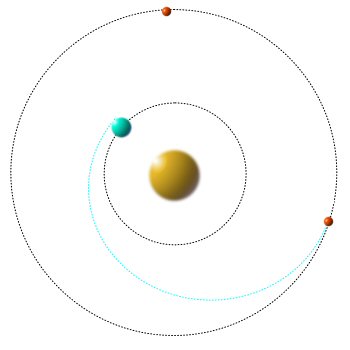
Granted, this is a vast oversimplification. Estimates on how long a manned flight to Mars would take using the conventional approach range from a few months to a couple of years. But you get the idea. And contrast that approach to Mars with the approach that the proposed technology will allow:
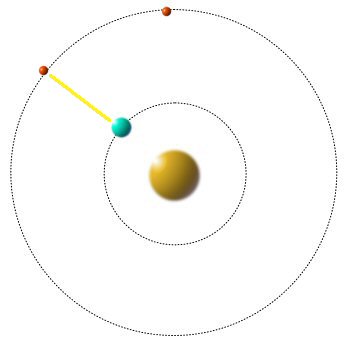
Quite a bit shorter of a trip, isn't it?
Of course, Mars isn't the only place to go in the solar system. Closer to home, a magnetic beam projector in low Earth orbit could push a spaceship to the moon in about ten hours. Interestingly, at that rate, if you took the space elevator up from Earth, the trip from Earth to orbit would take quite a bit longer than the trip from Earth orbit to the moon. Over longer distances, the advantages of the magnetic beam approach seem to dissipate. According to my (admittedly highly suspect) calculations, the magnetic beam that gets us to Mars in 80 days could get us to Neptune in about 12 years.
That is one big solar system we live in, folks.
Unless I'm mistaken, it also takes us about 12 years to get to Neptune using the old orbital intersection approach. We will have to crank up the output of the magnetic beam projector — which, as noted above, is exactly what Winglee intends to do — before we see any real advantage over those kinds of distances.
In addition to making travel within the solar system much less expensive and more practical, magnetic beam propulsion technology can serve as a precursor to solar sail technology. Frank Tipler has proposed the idea of focusing the energy of the sun into a laser beam which we could then use to launch a very small (you could hold it in your hand) interstellar probe. According to Tipler, such a probe could be accelerated to about .9c (90% of the speed of light) within about a month and a half. That means that we could have it to Alpha Centauri in less than five years, with information coming back in less than 10. Contrast that with 12 years to get to Neptune on a magnetic beam. Now we're talking speed.
(Not that AC that would necessarily be our first target; I think Kathy would agree that Epsilon Eridani would make an excellent choice.)
But wait. How much interstellar exploration could we really get done using such a tiny probe? Well, that's where nanotechnology comes in.
See how all this stuff fits together?
Comments
Lasers would be able to take over at the longer distances. They lose power at 1/r^2, but visible light frequencies can be focused quite well.
A cool idea I heard from William Mook on the sci.space.tech list (no idea where it originally came from) was to surround the Sun with mirrors well within the orbit of Mercury. One could then beam significant power to ridiculous distances (Mr. Mook had estimated 100 light years if the mirrors were placed a million kms out) and still illuminate Earth and other desirable locations in the Solar System.
Posted by: Karl Hallowell![[TypeKey Profile Page]](http://www.blog.speculist.com/nav-commenters.gif) |
October 19, 2004 01:52 PM
|
October 19, 2004 01:52 PM
Doh. I need to read these articles through. You mention the laser beam next. Sorry.
Posted by: Karl Hallowell![[TypeKey Profile Page]](http://www.blog.speculist.com/nav-commenters.gif) |
October 19, 2004 01:52 PM
|
October 19, 2004 01:52 PM
Hrmmm, not sure about Epsilon Eridani. It'll probably be pretty chilly unless the gas giant is warm enough.
Posted by: Karl Hallowell![[TypeKey Profile Page]](http://www.blog.speculist.com/nav-commenters.gif) |
October 19, 2004 01:54 PM
|
October 19, 2004 01:54 PM